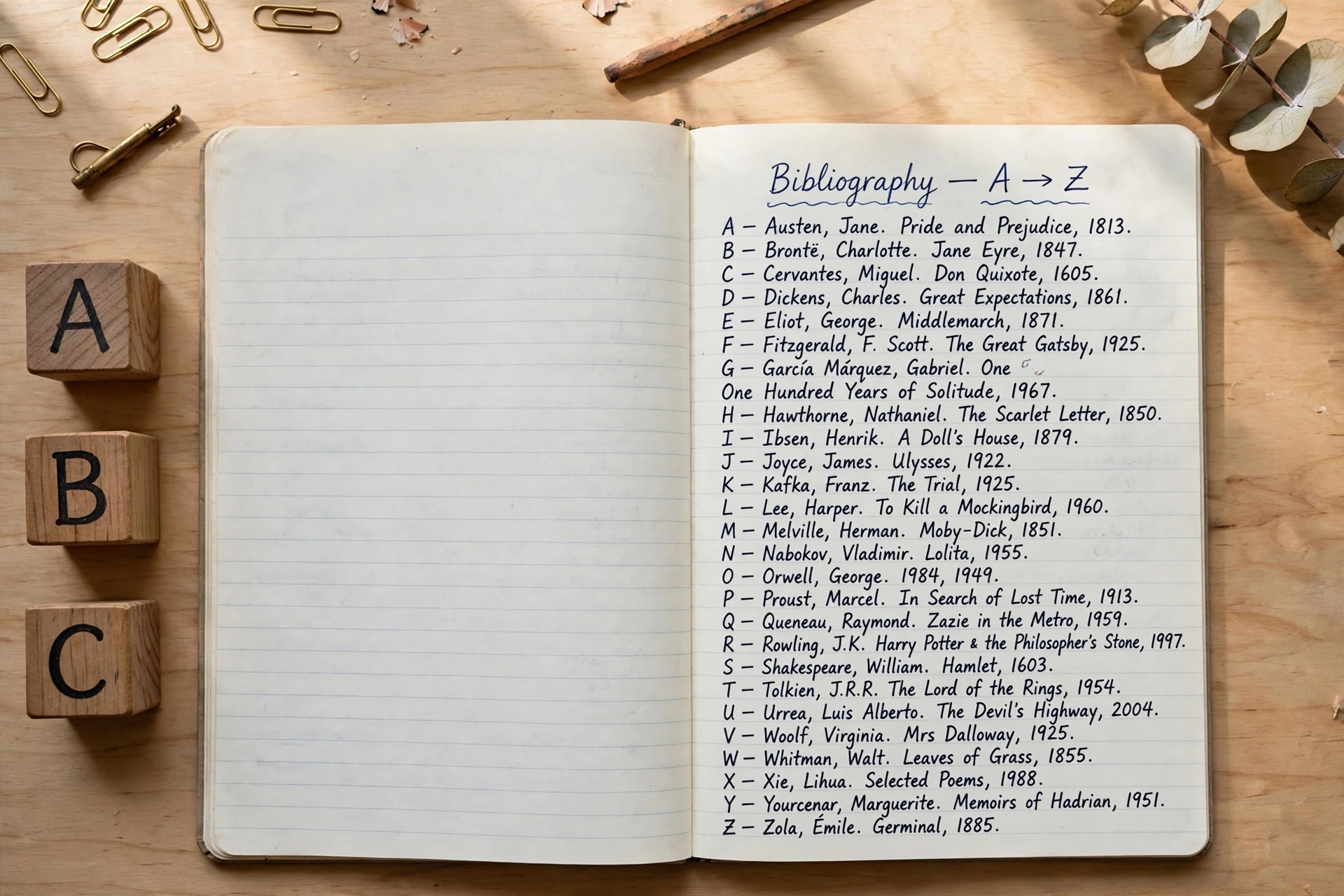
A scrambled bibliography is one of the first things a professor or editor notices, and fixing it is pure mechanics rather than judgment. The short answer: sort every entry A to Z by the author's surname, ignore A, An, and The when a title leads the entry, and put numbered entries before lettered ones. That one sentence handles roughly 90 percent of real reference lists. The tricky 10 percent is below: MLA's letter-by-letter sorting, APA's year ordering, numbers, name prefixes, and entries with no author, plus a full before-and-after example you can check your own work against. If you are polishing the whole paper at the same time, our word counter checks your length in seconds.
Find the Sorting Key for Each Entry
Every citation has one "sorting key", the word your bibliography is actually ordered by. Identify it before you sort anything. The key is usually the author's surname, but it changes when the author is an organization or when there is no author at all:
| Entry starts with | Sorting key | Why |
|---|---|---|
| Martin, Sarah. | Martin | Individual author, file by surname |
| Centers for Disease Control and Prevention. | Centers | Organization as author, file by its full name |
| The Baking Handbook (no author) | Baking | Title leads, so drop The |
| 2020 Annual Report (no author) | 2020 | Numerals sort before letters |
Two habits prevent most sorting mistakes. First, never file an organization under its acronym: the Centers for Disease Control goes under C, not under CDC. Second, do not invent an author when the source has none. A title-led entry is filed by its title, not squeezed into the author sequence.
MLA Works Cited Rules
MLA keeps the mechanics simple, with one rule that surprises almost everyone:
- Sort by the first author's surname. Invert only the first name: Smith, John, and Anna Lee. Co-authors after the first keep their normal order and do not affect the sort.
- Ignore A, An, and The at the start of a title. The Cambridge Companion files under C.
- Sort letter by letter, ignoring spaces and punctuation. This is the surprising one. Because spaces are ignored, Newark files before New York: letter by letter, "Newa" comes before "Newy". Word-by-word sorting would reverse them, so always strip the spaces in your head.
- Two works by the same author: replace the repeated name with three hyphens (---) and order the works by title, again ignoring A, An, and The. Example: Smith, John. ---. "Bread." ---. "Cake." sorts by "Bread" before "Cake".
- Use the full first name when surnames tie. Smith, Anna before Smith, John. Only after first names tie do you move to the title.
APA Reference List Rules
APA follows the same surname logic but adds initials and a year system for same-author works:
- Sort by surname, then by initials. Smith, A. files before Smith, B. when the surnames match.
- One author, several works: order them by year, earliest first. The author's research story should read chronologically.
- Same author, same year: add lowercase letters after the year based on title order. Smith (2020a). Apples. comes before Smith (2020b). Oranges.
- Same first author, different co-authors: sort by the second author's surname.
- No author: file by the first significant word of the title, ignoring A, An, and The.
- Numerals lead: an entry starting with a number files before all lettered entries, in numerical order.
Numbers, Symbols, and Name Prefixes
This is where hand-sorted lists usually break. Handle each case this way:
- Leading numerals go first, numerically. 1984 before 2020 Annual Report before Apple Harvest.
- Ignore punctuation in the sort. E-mail files as Email, and O'Brien as OBrien. The punctuation prints in the entry but plays no role in the order.
- File prefixes exactly as spelled. MacDonald comes before McDonald because the letter a precedes c. Do not merge prefixes into one group.
- St. versus Saint: sort by the letters actually printed. St. Clair files under S-t, Saint Clair under S-a, exactly as the source spells them.
- Exact ties: when two keys match letter by letter (for example De Witt and Dewitt with the space ignored), break the tie with the next word, usually the first name or the title.
Entries With No Author
Sources without a named author, such as unsigned articles, reports, and most web pages, still belong in the same A to Z sequence. Start the entry with the title and file it by the first significant word, skipping A, An, and The. One exception: when an organization published the work, treat the organization as the author and file by its full name, as shown in the sorting key table above. Never write "Anonymous" unless the work is literally signed that way, and never invent an author to fill the gap.
Worked Example: Before and After
Here is a six-entry Works Cited list as students usually draft it, in the order sources were found, followed by the correctly sorted version. Each move is explained so you can apply the same logic to your own list. Building a small example like this by hand takes a few minutes; for a real list of thirty or forty entries, paste them into our free alphabetize list tool to sort them instantly, then use these rules to check the tricky cases the tool cannot judge.
Before (unsorted)
- Smith, John. Modern Baking Techniques. New York: Kitchen Press, 2023.
- The Cambridge Companion to Short Stories. Cambridge UP, 2019.
- Anderson, Peter. "Why Zebras Matter." Nature Notes 12 (2019): 4-9.
- Zhao, Lin. "Solar Panels in Cold Climates." Energy Journal 8 (2021): 44-52.
- 2024 Urban Gardening Guide. Portland: Green Thumb Books, 2024.
- Brown, Anna. The Art of Bread. London: Crumb Press, 2020.
After (sorted)
- 2024 Urban Gardening Guide. Portland: Green Thumb Books, 2024. (Numerals lead, so this entry moves to the top.)
- Anderson, Peter. "Why Zebras Matter." Nature Notes 12 (2019): 4-9. (Surname A comes first among the named authors.)
- Brown, Anna. The Art of Bread. London: Crumb Press, 2020. (Brown follows Anderson; the title's The does not affect the author sort.)
- The Cambridge Companion to Short Stories. Cambridge UP, 2019. (No author, so the key is Cambridge, with The dropped.)
- Smith, John. Modern Baking Techniques. New York: Kitchen Press, 2023. (Smith after Cambridge: S follows C.)
- Zhao, Lin. "Solar Panels in Cold Climates." Energy Journal 8 (2021): 44-52. (Z is the last initial in the set.)
Notice that only two rules did all the work: numerals first, and the sorting key for each entry. Once the keys are right, the order writes itself.
Frequently Asked Questions
How do you alphabetize citations in MLA format?
List entries by the author's surname from A to Z. Ignore the words A, An, and The when a title starts the entry, sort letter by letter with spaces and punctuation ignored, and for two works by the same author replace the repeated name with three hyphens and order them by title.
How do you alphabetize references in APA format?
Order the reference list by author surname, then by initials when surnames match. Works by the same author go in year order, earliest first. When the year is also the same, add a, b, and c after the year based on the titles, and file no-author entries by the first significant word of the title.
Do you ignore "The" when alphabetizing a bibliography?
Yes. Both MLA and APA drop the articles A, An, and The when a title leads the entry, so The Baking Handbook files under B for Baking, not T for The.
Where do numbers go in an alphabetized citation list?
Entries that begin with a numeral go before every lettered entry, arranged in numerical order. A 2020 report files before anything that starts with the letter A.
How do you alphabetize a citation with no author?
Start the entry with the title and file it by the first significant word, skipping A, An, and The. If an organization published the work, use the organization name as the author instead.
As a final pass, run your finished list through our alphabetize list tool to catch the entries you moved by hand, and double check any titles starting with A, An, or The. Teachers assembling class materials may also like our classroom random picker ideas, which include more ways to organize student reading lists.
Related Articles
- Free Alphabetize List Tool
- Essay Word Count Guide
- Classroom Random Picker Ideas
- Free Word Counter
- Title Case vs Sentence Case